The short answer: you need both. Professional photography and a Matterport 3D tour do different things for different stages of the buyer's decision process. Photos attract the initial click. The 3D tour converts that click into a qualified showing. Treating them as interchangeable — or worse, as an either/or choice — misunderstands what each format actually delivers.
This post breaks down exactly what professional real estate photography does well, where it falls short, what a Matterport 3D tour adds that photos cannot replicate, and how the two formats work together in a modern listing strategy.
What Professional Photos Do Well
Professional real estate photography is the foundation of listing marketing, and nothing in this post argues otherwise. A skilled photographer with proper lighting, lens selection, and composition produces images that stop a buyer mid-scroll. Professional photos set the emotional tone of a listing. They highlight the best features of a home — the kitchen island, the fireplace, the view from the primary suite — in their most flattering light. They create the first impression, and on listing portals where buyers scroll past dozens of thumbnails in seconds, that first impression determines whether anyone clicks in at all.
Photography excels at selective presentation. A good photographer knows which angle makes a room feel largest, which time of day produces the warmest light, and which composition draws the eye to the feature that sells. That curation is a genuine skill and a genuine advantage. A listing with 25 professional photos will always outperform one with 25 phone snapshots.
If your budget allows for only one visual investment, professional photography is the right choice. It's the minimum professional standard.
Where Photos Fall Short
The same qualities that make photography effective — selective framing, flattering angles, careful composition — are also its limitations.
Photos can't communicate layout
A set of 25 photos shows 25 individual moments inside a home. It does not show how those moments connect. A buyer looking at a photo of the kitchen and a separate photo of the dining room has no way to understand how close those rooms are to each other, whether there's a wall between them, or how the flow works in practice. The spatial relationship between rooms — which is one of the most important factors in a buyer's decision — is invisible in a photo set.
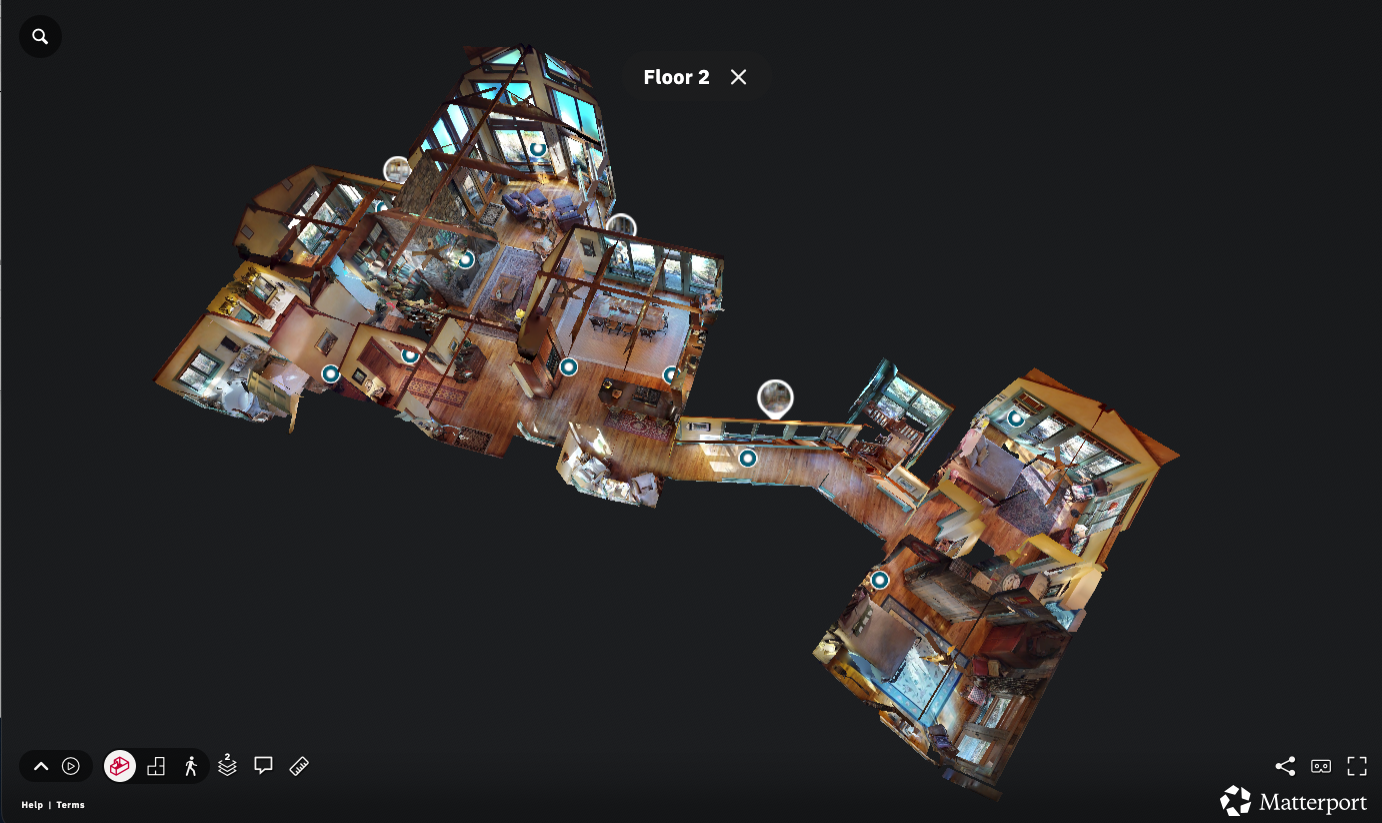
A Matterport tour solves this completely. The buyer navigates from kitchen to dining room themselves, turns around, looks back, and understands the relationship between spaces because they've walked through it. The Dollhouse view goes further, showing the entire home as a three-dimensional model from above — something no number of photos can replicate.
Photos can't be measured
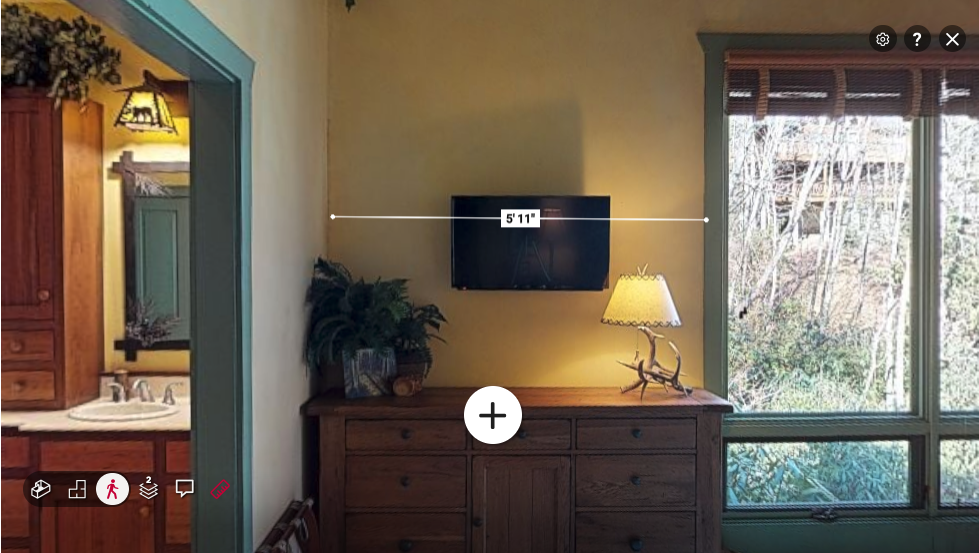
When a buyer sees a photo of a bedroom and wonders whether their king bed and two nightstands will fit, they have two options: drive to the house with a tape measure, or ask the agent. Neither is efficient. Every Matterport tour includes a built-in measurement tool that lets any viewer measure the distance between any two points in the space — wall to wall, floor to ceiling, doorway width, counter depth. This eliminates an entire category of follow-up questions that slow down the buying process.
Photos can mislead about scale
Wide-angle lenses are the standard tool in real estate photography. They make rooms look significantly larger than they are — sometimes 30% to 50% larger, depending on the focal length. Most buyers know this at some level, which means professional photos create a trust gap. The buyer expects the room to be smaller than it looks in the photo. They just don't know how much smaller.
This trust gap has a real cost. When a buyer arrives at a showing and discovers that the "spacious" primary bedroom is actually average-sized, the mismatch between expectation and reality colors their entire experience. They start looking for other discrepancies. The showing turns defensive instead of aspirational.
A Matterport tour doesn't use selective framing. The buyer sees the room at its actual proportions and can measure it. If the room still looks good in the 3D tour — and it usually does, because most homes present well when shown honestly — the buyer arrives at the showing with calibrated expectations. There's no letdown, no trust gap, and no defensive mindset.
Photos are passive; tours are interactive
A photo gallery is a passive experience. The buyer scrolls through images someone else selected, in an order someone else chose, showing angles someone else decided on. A Matterport tour is an active experience. The buyer chooses where to go, how long to stay, what to look at, and when to come back. That shift from passive browsing to active exploration is one of the main reasons listings with 3D tours generate three to five times longer engagement than photo-only listings.
Longer engagement matters for two reasons. First, a buyer who spends 8 minutes exploring a property is more emotionally invested than one who spends 30 seconds flipping through photos. Second, listing portals track engagement metrics, and listings with higher engagement tend to surface more often in search results — creating a compounding visibility advantage.
Photos can't be revisited meaningfully
After a showing, a buyer goes home and tries to remember the layout. They pull up the listing photos and look at the kitchen again, but they can't walk from the kitchen back to the living room to check how the two rooms feel together. They can't re-examine the closet in the second bedroom. They're stuck with 25 static images and their fading memory.
A Matterport tour is available at any time, for as many visits as the buyer wants. This is especially important for relocation buyers comparing homes from a distance and for group decisions where multiple family members need to evaluate the same property independently. The tour doesn't degrade with memory. It's the same experience on the fifth virtual visit as it was on the first.
What a Matterport 3D Tour Adds
To be specific about what a Matterport tour delivers that photography does not:
| Capability | Professional Photos | Matterport 3D Tour |
|---|---|---|
| First impression / emotional hook | Excellent — curated, flattering, designed to attract clicks | Functional — accurate but not designed for thumbnails |
| Layout and spatial flow | Cannot communicate room-to-room relationships | Buyer navigates the entire home; Dollhouse shows full layout |
| Room measurements | Not available | Built-in measurement tool, accurate to ~1% |
| Buyer control | Passive — buyer views what photographer chose | Active — buyer chooses where to go and what to examine |
| Engagement time | 30 seconds to 2 minutes typical | 5 to 12 minutes typical; 3–5x longer than photos alone |
| Revisitability | Buyer can re-view photos but can't re-explore | Buyer can return to the tour unlimited times |
| Accuracy of scale | Wide-angle lenses distort room size | Dimensionally accurate; no lens distortion |
| Floor plan | Not generated from photos | Schematic floor plan generated automatically from scan data |
| Shareability for group decisions | Photo link is useful but limited | Each person can explore independently at their own pace |
| Remote buyer confidence | Moderate — buyers still need to visit | High — buyers can evaluate thoroughly from any location |
The "Use Both" Strategy
The most effective listing marketing uses photography and Matterport together, because each format serves a different moment in the buyer's journey.
Photography is the hook. The hero image on the MLS listing, the thumbnail on Zillow, the Instagram post that catches someone's eye — these are photo-driven moments. The goal is to make the buyer stop scrolling and click. Professional photography is unmatched at this job.
The 3D tour is the conversion tool. Once the buyer clicks in, the tour is where they decide whether this home is worth a showing. They walk through the space, check the layout, measure the rooms, view the floor plan, explore the Dollhouse view. The tour answers the buyer's real questions — not "does this home look nice?" but "does this home work for my life?" — and the answer determines whether they book a showing or move on.
After the showing, the tour keeps working. The buyer goes home and compares two or three finalists. The listing with a 3D tour gives them something to revisit and share. The listing with only photos gives them a memory that's already fading. The tour keeps your property top of mind through the decision process, which is especially important when days pass between the showing and the offer.
This is why we recommend 3D tours on every listing where budget allows, used alongside — not instead of — professional photography. They aren't competing formats. They're complementary tools with different jobs.
The Cost Comparison
Professional real estate photography typically costs $150 to $500 per session depending on the market, property size, and photographer. Drone/aerial photography adds $100 to $300. Virtual staging for vacant properties adds $25 to $75 per image.
A Matterport 3D tour is typically priced at $0.10 to $0.20 per square foot, depending on the provider and market. At Southeast 3D Tours, the rate is $0.14 per square foot with a $225 minimum. A 2,500 square foot home is $350. A 4,000 square foot home is $560. The tour includes 12 months of hosting, a shareable link, embed code, Dollhouse and Floor Plan views, and the measurement tool.
For a typical listing, the combined cost of professional photography and a Matterport tour is $500 to $900. On a $400,000 listing with an average commission, that's well under 1% of the transaction value — and it gives the listing the strongest possible visual marketing package available today.
When Photos Alone Are Sufficient
In the interest of being honest about where the line is, here are situations where professional photography alone may be adequate.
Extremely low price points with guaranteed quick sales. If a property is priced to sell in under a week regardless of marketing — a fixer-upper in a hot market, a below-market estate sale — the 3D tour adds value but may not change the outcome. The buyer pool for deeply discounted properties is less sensitive to marketing quality.
Properties with restrictions on virtual access. Some sellers, particularly for security or privacy reasons, prefer not to have a navigable 3D model of their home accessible online. This is uncommon, but it happens — and in those cases, photos and video are the appropriate formats.
Genuinely constrained budgets. If the total marketing budget for a listing is $300 and the agent must choose between professional photography and a 3D tour, photography should win. The first impression on the portal thumbnail matters more than anything else in driving clicks, and that's a photography job.
In virtually every other scenario — and especially for listings targeting relocation buyers, luxury buyers, vacation rental guests, or any buyer who needs to evaluate a property remotely — the 3D tour adds measurable value over photos alone.
When a 3D Tour Makes the Biggest Difference Over Photos
Certain situations amplify the gap between what photos can do and what a 3D tour delivers.
Multi-level homes. A split-level, three-story, or multi-wing home is nearly impossible to understand from photos. The buyer can't piece together how the floors relate to each other. The Dollhouse view solves this instantly — it's the single most effective way to communicate the layout of a complex home.
Unique or unconventional floor plans. Lofts, open-concept conversions, historic homes with unusual room configurations, and custom builds all benefit from 3D tours because the layout isn't intuitive from photos. The buyer needs to walk through it to understand how the space works.
Relocation and out-of-state buyers. A buyer moving from another state can't easily return for a second showing. The 3D tour is their second showing, third showing, and comparison tool. It's the closest thing to being inside the home without physically being there. More on how 3D tours serve relocation buyers.
Vacant homes. Empty rooms are the hardest spaces to photograph effectively because there's no furniture to provide scale or warmth. In a 3D tour, the buyer can at least measure the rooms and understand the layout — which is harder to do from photos of empty white boxes.
Luxury listings. At higher price points, buyers expect immersive marketing. A $1.5 million home listed with only photos signals a lack of investment from the agent. A Matterport tour signals premium marketing that matches the property's positioning.
Listings competing for attention in crowded markets. When 15 similar homes are listed in the same price range and neighborhood, the one with a 3D tour stands out on portals that feature "virtual tour" badges or filters. It's a visibility advantage that photos alone can't provide.
What About Video Tours?
Video walkthroughs — either agent-narrated or cinematic — are a third visual format some agents use. Video has strengths: it's good for storytelling, social media, and giving a curated tour of highlights. But video shares photography's fundamental limitation: the viewer sees what someone else chose to show them, in the order they chose to show it.
A Matterport 3D tour is not a video. It's an interactive model the buyer controls. Video is linear; the tour is nonlinear. Video can't be measured; the tour can. Video shows a path through the home; the tour lets the buyer choose their own path. The two formats serve different purposes, and a 3D tour is not a substitute for a well-produced listing video any more than a video is a substitute for a 3D tour.
For agents who use video, the strongest approach is all three: photos for the click, video for social media and email, and the Matterport tour for the serious evaluation that leads to a showing.
Frequently Asked Questions
Does a 3D tour replace the need for professional photography?
No. Photography and 3D tours serve different purposes. Photos create the first impression and drive the initial click on a listing portal. The 3D tour converts that click into a qualified showing by letting the buyer explore the space interactively. The strongest listing marketing uses both.
Can I use photos from the Matterport scan instead of hiring a photographer?
Matterport generates high-resolution snapshots from the 3D model, and some agents use these as supplemental images. However, they are not equivalent to images produced by a professional photographer with dedicated lighting, lens selection, and composition. For hero images and portal thumbnails, professional photography is still the better option.
How long does each take?
A professional photography session typically takes 1 to 2 hours on-site. A Matterport scan takes about 60 to 90 minutes for a typical home. Both can often be scheduled on the same day — some providers (including Southeast 3D Tours) offer photography and 3D scanning in a single visit. Preparation is the same for both: clean the home, turn on lights, open blinds, clear countertops.
Is a 3D tour worth it on a $250,000 listing?
Often yes. The cost-to-value ratio is actually better at moderate price points because fewer competing agents are investing in 3D tours below $400,000. The differentiation is more visible, not less. At a $225 minimum, the investment is less than 0.1% of the listing price.
What do buyers actually prefer — photos or 3D tours?
Buyers use both, but for different purposes. They use photos to decide whether a listing is worth a closer look, and they use the 3D tour to decide whether it's worth a showing. Industry data consistently shows that listings with both formats generate more engagement, more qualified leads, and shorter time on market than listings with either format alone. See the full data breakdown.
The Bottom Line
Professional real estate photography and Matterport 3D tours are not competing formats — they're complementary tools that serve different stages of the buyer's decision process. Photos attract attention. Tours build understanding. Photos make a listing look appealing. Tours make it feel real. The agents who use both are giving their listings the strongest possible marketing foundation, and in a market where buyers evaluate homes online before they ever schedule a showing, that combination is the difference between a listing that gets scrolled past and one that gets booked.
If you're only using photos today, you're doing the right thing at the first-impression stage and leaving value on the table at every stage after it.
Ready to add Matterport to your listing marketing? Book a scan or reach out at james@southeast3dtours.com / 864.351.4255. Full pricing is on the pricing page. Questions? Check the FAQ.